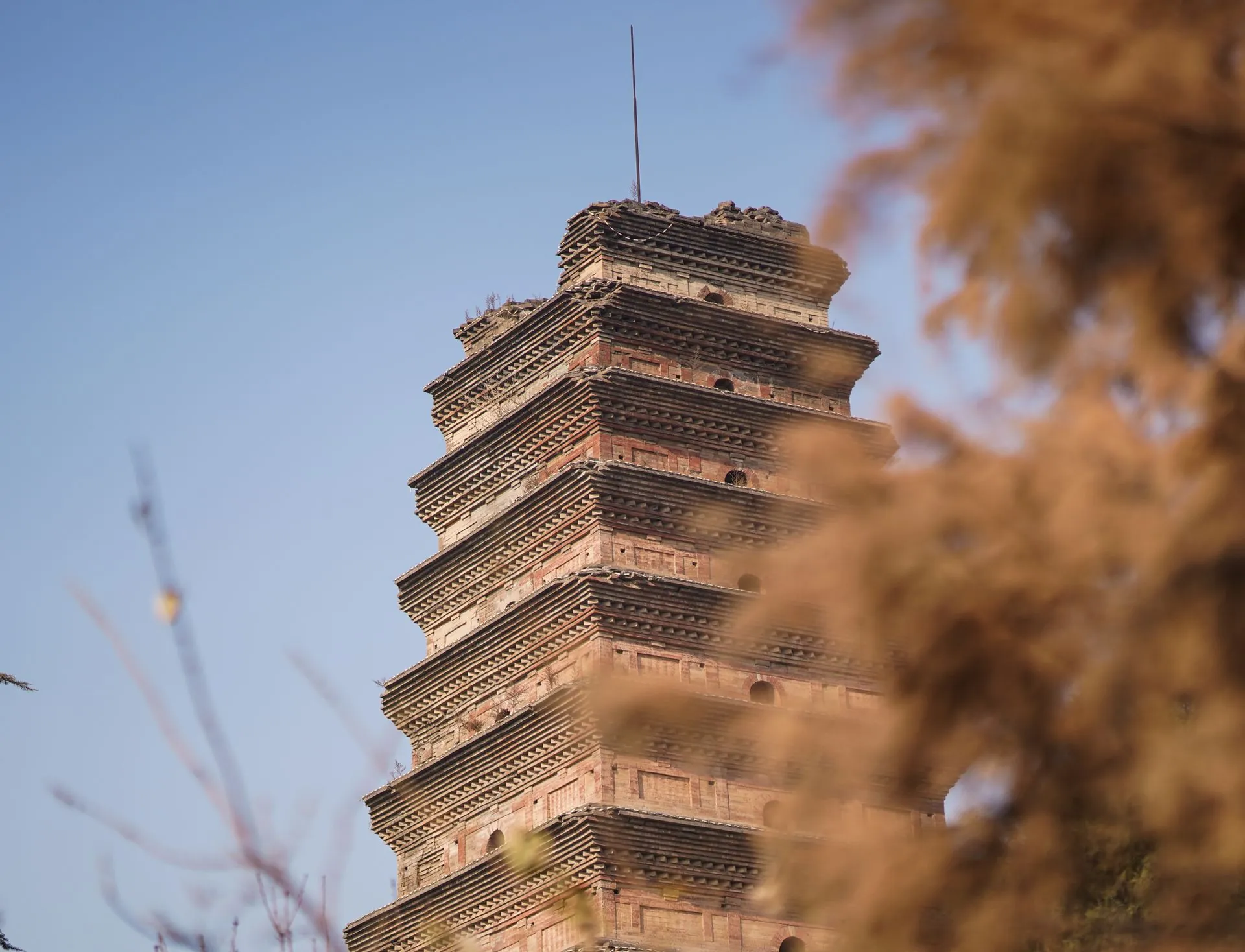
Dayan Ta · Xi'an, Shaanxi · 652 CE
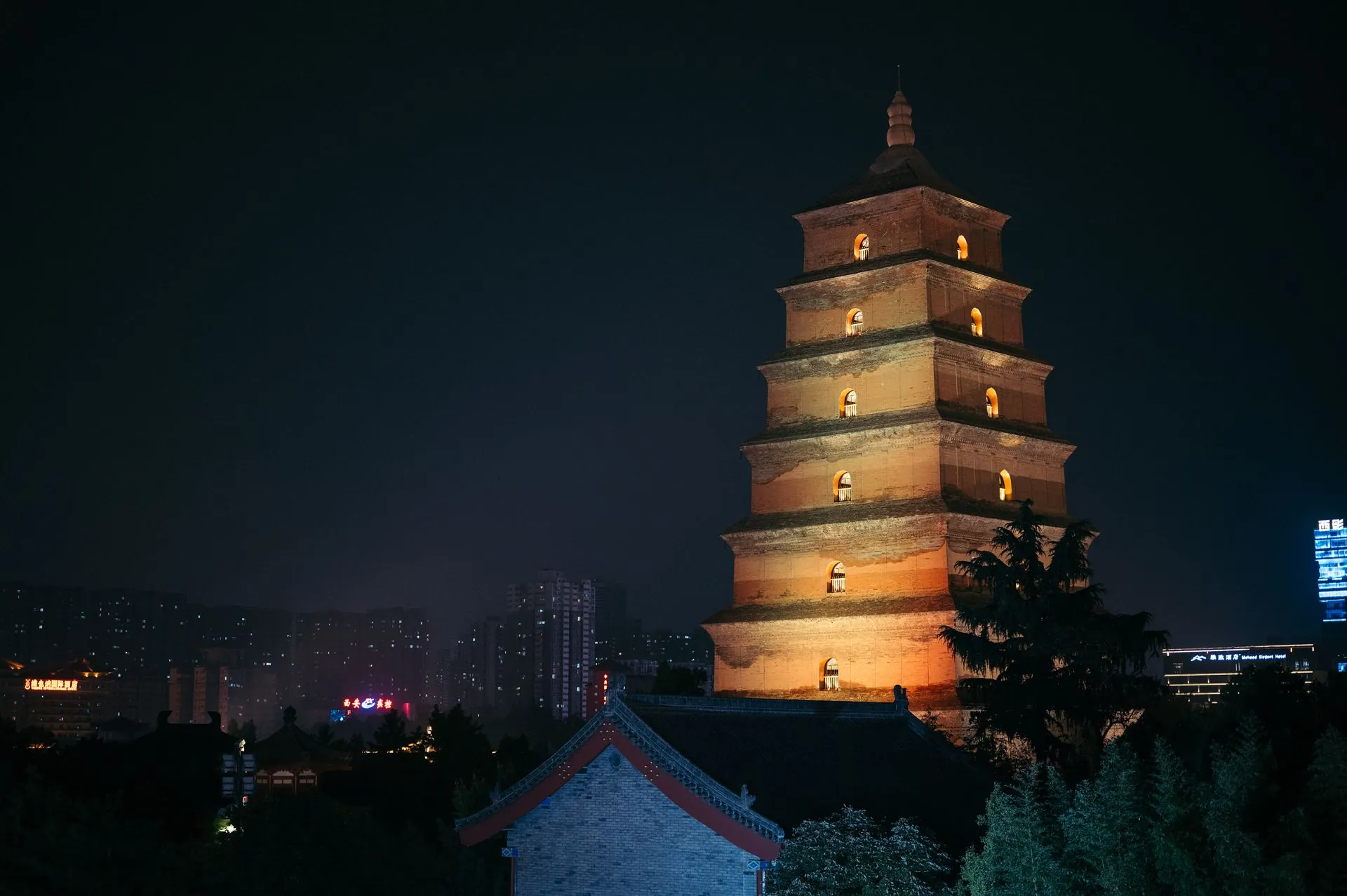
The Giant Wild Goose Pagoda is the most iconic surviving monument of Tang dynasty Chang'an and one of the finest examples of Chinese brick pagoda architecture. Built in 652 CE to house the Buddhist scriptures brought from India by the pilgrim monk Xuanzang, the original five-story tower was expanded to seven stories and 64 meters in 704 CE. As the only major Tang structure surviving in Xi'an, it preserves the proportions, masonry techniques, and spiritual purpose of China's golden-age architecture.
After 17 years and roughly 50,000 kilometers of travel through Central Asia and India, the monk Xuanzang returned to Chang'an in 645 CE with 657 volumes of Sanskrit scriptures. The emperor Gaozong ordered the pagoda built in 652 CE within the Da Ci'en Temple to house the texts and Xuanzang's translation bureau, where he and his team produced 75 works in 1,335 volumes — including the Great Tang Records on the Western Regions, the source for the novel Journey to the West.
The pagoda's name comes from a legend told across the Silk Road: a starving flock of wild geese was saved when one great goose sacrificed itself, and the monks who witnessed it became vegetarians. The smaller companion, the Small Wild Goose Pagoda, stands 3 kilometers away — the two towers bracketing the southern skyline of Tang Chang'an like twin sentinels of the faith.
Unlike the timber architecture that dominated Tang building, the Giant Wild Goose Pagoda is built of brick laid up like a tower of stacked blocks — a Chinese adaptation of the Indian stupa. Its seven stories taper from 25 meters square at the base to 17 meters at the top, creating the characteristic graduated silhouette; the walls are 2 meters thick at ground level.
Each story opens with arched doorways on four sides, and the exterior carries recessed pilasters and projecting lintels carved in brick to imitate wooden framework — evidence that even masonry buildings were designed according to timber logic. Inside, a spiral staircase of 248 steps rises through the core. The pagoda belongs to the louge (multi-story) type rather than the solid mishan (dense-eave) type of the Small Wild Goose Pagoda, and its surviving 8th-century brickwork is among the best-preserved Tang masonry in China.
The pagoda stood within the Da Ci'en Temple in the eastern ward of Chang'an, the largest city in the medieval world — a grid of 84 square kilometers with more than a million residents. Climbing the tower for a view of the capital became a rite: successful candidates in the imperial examinations inscribed their names on the pagoda in the tradition of 'yan ta ti ming' (goose pagoda name-inscribing), and Tang poets celebrated the panorama in verse that made the tower the standard image of Chang'an.
The monument survived the fall of the dynasty and the city's decline, though earthquake damage in the 16th century and later repairs changed its proportions slightly. In 2014 it was inscribed as part of the UNESCO Silk Roads: Routes Network World Heritage corridor, and today it anchors Xi'an's skyline — the one structure in the modern city that a Tang traveler would instantly recognize.
Best Time to Visit
March-May and September-November; spring for peonies in the temple garden
Photography Tips
Symmetrical front elevation at blue hour; climb to top for Xi'an skyline at sunset
How to Get There
Xi'an Metro Line 3/4 to Dayanta Station; the pagoda is inside Da Ci'en Temple, south of the city center
Yes — visitors can ascend the spiral staircases to the top floor for panoramic views over Xi'an. Climbing is popular at sunset, when the surrounding temple complex and the modern skyline are both illuminated.
Centuries of soil settlement beneath its massive brick base have given the tower a slight but visible lean to the west. It has been stabilized in modern restorations, and the tilt — roughly 1 meter at the top — has been monitored since the 1990s.
According to the legend, a starving flock of wild geese was saved by one great goose that sacrificed itself; the monks, moved by the act of compassion, became vegetarians and the pagoda took the name Dayan (Great Wild Goose) Ta. A smaller companion, the Small Wild Goose Pagoda, stands 3 kilometers away.