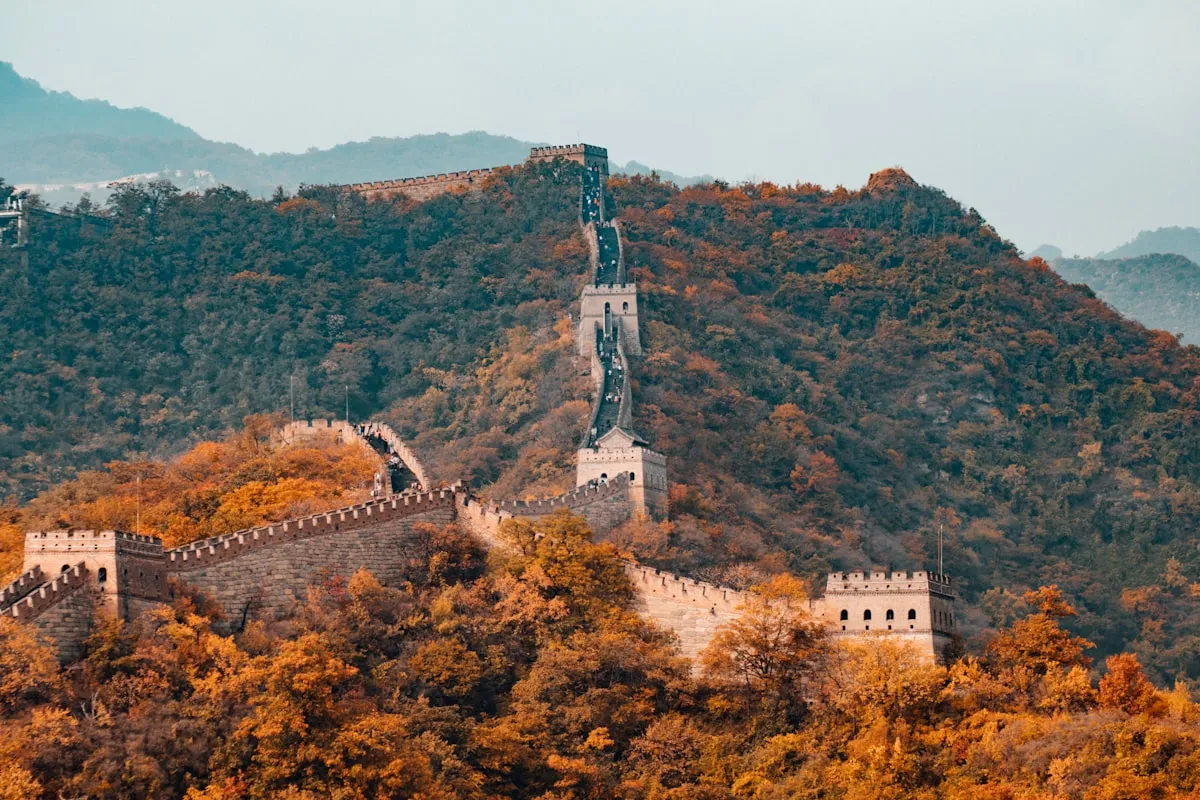
Changcheng · Northern China · Various (Ming sections: 14th-17th c.)
The Great Wall is the world's longest defensive structure, stretching over 21,000 kilometers across northern China. While sections date back to the Qin dynasty, the most famous and photogenic segments — including Badaling and Mutianyu near Beijing — were built or rebuilt during the Ming dynasty using brick and stone. The wall is not a single continuous line but a network of walls, watchtowers, beacon towers, and fortresses.
The Ming wall replaced earlier rammed-earth versions with brick and stone facing over a rubble core. Watchtowers were placed at regular intervals (approximately every 500 meters), providing shelter for guards and platforms for signaling. Crenellations on the outer face allowed archers to fire while remaining protected.
Ming builders standardized the profile: a wall base roughly 6 meters wide, a top 4-5 meters wide, and a height of 7-8 meters — wide enough for five horsemen or ten soldiers to march abreast. The facing bricks were fired in nearby kilns, and the rubble-and-earth core was compacted in layers. At the base, builders in wet regions used a mortar of lime and sticky rice paste (a mixture modern engineers tested in 2009 and found as strong as some modern concretes), which is why many Ming sections still stand where earlier walls crumbled.
Building across mountains, deserts, and rivers required extraordinary engineering. Workers used local materials where possible: stone in mountainous regions, rammed earth in the Gobi, and brick near the capital. The wall's path follows natural ridgelines for maximum defensive advantage, a strategy that also made construction extraordinarily difficult.
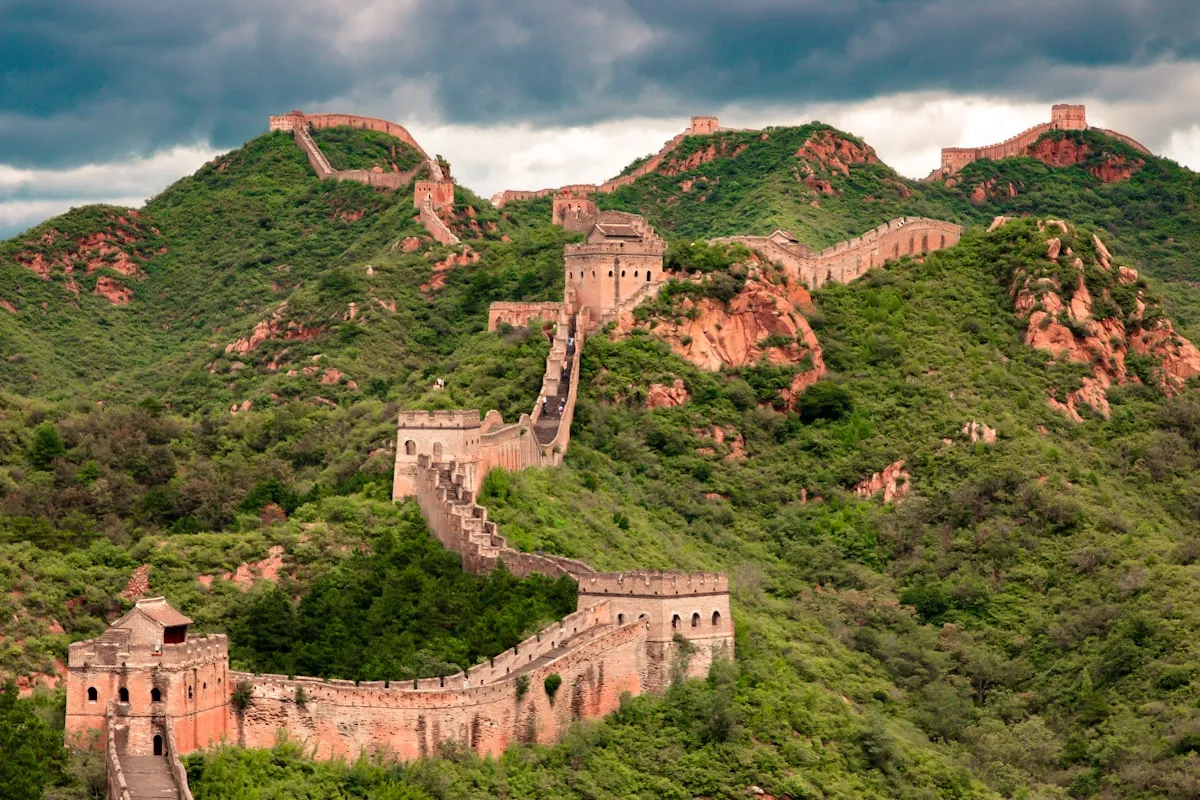
On steep passes the builders stepped the wall like giant stairs, and where the ridge dropped away, they raised the outer face high enough to prevent attackers from climbing over. Water management was equally demanding: drainage gaps (gully arches) in the wall body let mountain streams pass through rather than breach the structure, and the crenellated parapet — merlons and crenels — gave archers cover while leaving clear sightlines down the slopes.
Only about 8% of the original Ming wall remains in good condition. Sections like Badaling (the most visited) have been heavily restored, while wild sections like Jiankou offer crumbling, overgrown remnants that attract adventurous hikers and photographers.
The scale is often understated: the 2012 official survey measured the entire network at 21,196.18 kilometers — more than half the Earth's circumference — including 43,721 watchtower sites identified along its branches. Restoration continues at famous sections like Mutianyu and Jiankou, where conservation teams rebuild collapsed parapets with traditional lime-and-brick techniques rather than modern concrete.
Best Time to Visit
October for autumn foliage; avoid summer weekends and Chinese holidays
Photography Tips
Mutianyu at sunrise for golden light; Badaling for mountain backdrop; Jiankou for adventurous shots
How to Get There
Mutianyu: 2hr drive from Beijing; Badaling: S2 train from Beijing North Station
Mutianyu combines spectacular scenery with cable cars and a toboggan ride, Badaling is the most accessible with the best facilities, and Jinshanling offers the most photogenic unrestored sections for hikers. All three are reachable on a day trip from Beijing.
The 2012 official survey measured the complete network at 21,196.18 kilometers — including every branch and overlap built across 2,000 years of dynasties, not just the Ming-era wall tourists usually visit.
Yes. Badaling or Mutianyu can be done in a half day from central Beijing. Serious hikers combine the Jinshanling-Simatai trail, a 10-kilometer wild section that takes a full day and requires a return shuttle at the far end.