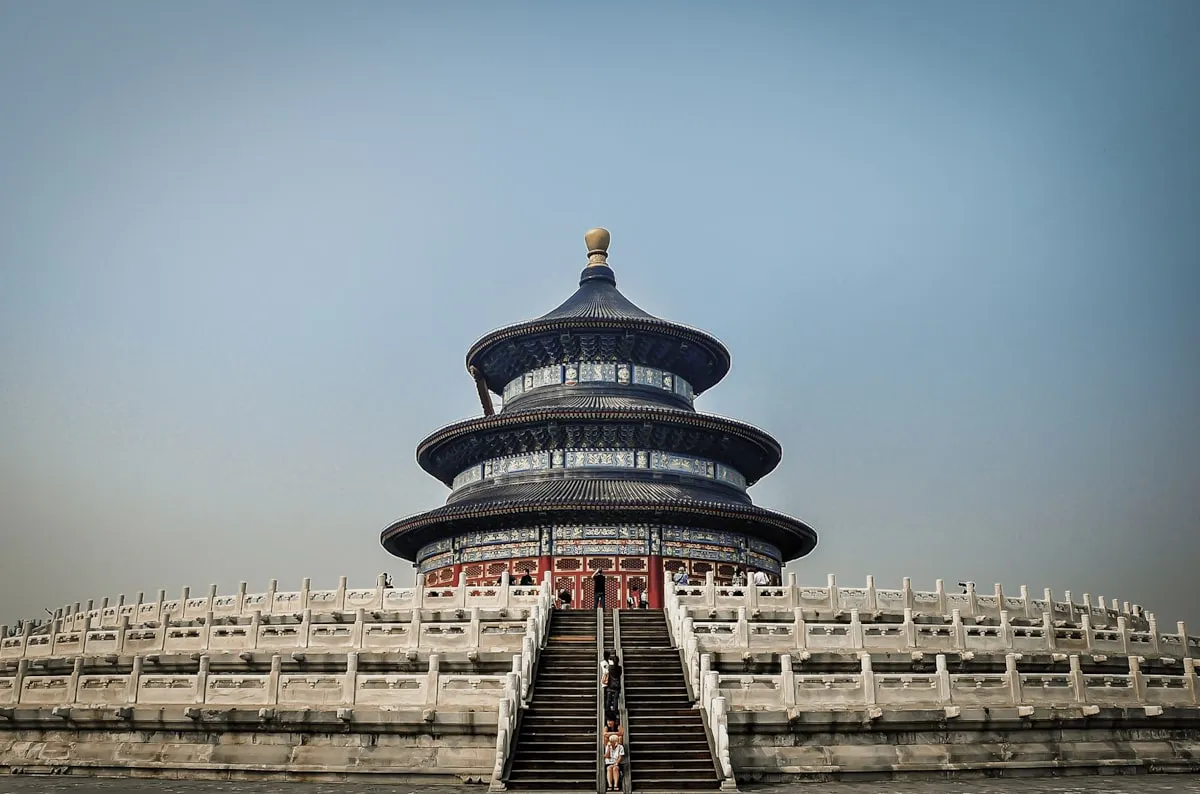
Tiantan · Beijing · 1420
The Temple of Heaven is the largest and most complete ritual complex surviving in China — a 273-hectare park where Ming and Qing emperors performed annual ceremonies to pray for good harvests. Its design encodes cosmology in every dimension: the round Hall of Prayer for Good Harvests rises 38 meters without a single nail, its 28 interior pillars standing for the 28 lunar mansions; the Circular Mound Altar is built so every stone slab follows multiples of nine, the most yang number in Chinese numerology. The entire complex is arranged as a ritual journey — the emperor's slow procession from the mundane city to the heart of heaven itself.
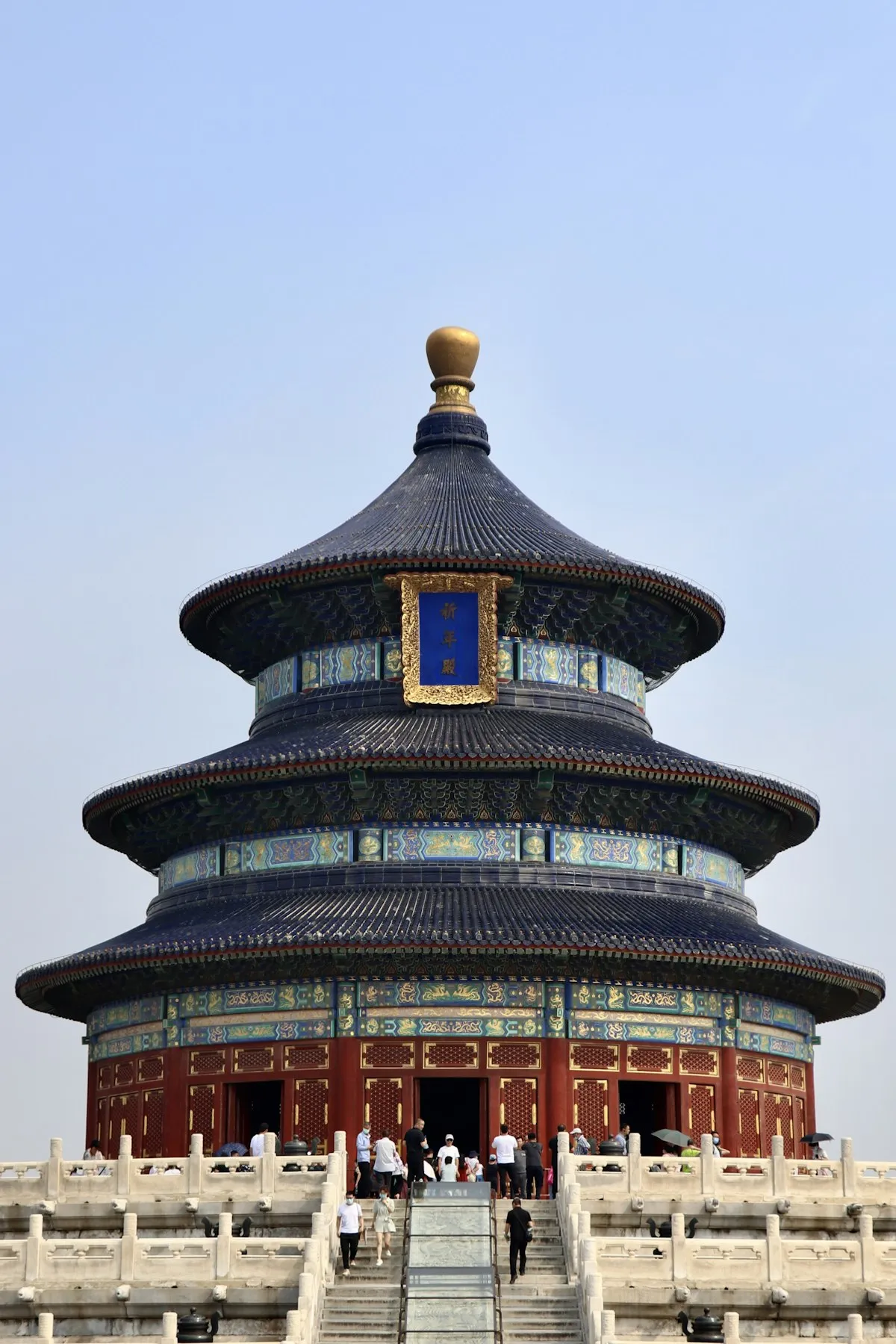
A triple-gabled circular wooden structure standing 38 meters tall without a single nail. Its three tiers of blue-glazed roof tiles symbolize heaven, and the 28 interior pillars represent the 28 lunar mansions of Chinese astronomy. The hall was rebuilt in 1889 after a lightning strike but faithfully reproduces the Ming original.
The 28 columns carry the load in three concentric rings: four central dragon columns, 19.2 meters high and nearly a meter in circumference, represent the four seasons; 12 inner columns represent the 12 months; and 12 outer columns represent the 12 double-hours of the day. The hall's double eave structure means the outer ring of columns supports only the lowest eave — a sophisticated load distribution that lets the tower's proportions narrow elegantly as it rises. All joints are mortise-and-tenon; the structure flexes, which is why it has survived 500 years of earthquakes.
An open-air platform of three marble tiers where the emperor performed the winter solstice ceremony. The number of stone slabs in each ring follows multiples of nine — the most yang (masculine, heavenly) number — culminating in 81 slabs in the outermost ring.
Every dimension of the altar repeats the same numerology: the innermost ring has 9 slabs, the next 18, and so on through nine rings to 81; the balustrade posts also number 360, matching the degrees of a circle. At the exact center lies the Heart of Heaven Stone — a single circular slab where a spoken word returns as an unusually resonant echo, the emperor's voice amplified by the surrounding concentric walls as if heaven itself answered.
Every number and shape in the complex carries symbolic meaning. The round forms represent heaven (tian), the square base represents earth (di). The blue roof tiles match the color of the sky. Even the path the emperor walked — the 360-meter Danbi Bridge — represents the journey from earth to heaven.
The Danbi Bridge rises 4 meters from south to north, so the emperor climbed gradually as he approached the altar, leaving the mundane city behind. The complex walls are round on the north side (heaven) and square on the south (earth), and the whole park is laid out so that the north, the emperor's seat of power, is ritually superior. The design is not decoration — it is a machine for staging the most important ritual in the Chinese state.
Best Time to Visit
Early morning in spring when locals practice tai chi in the park
Photography Tips
Symmetrical front shot from the south approach; blue roof tiles against a clear sky at mid-morning
How to Get There
Subway Line 5 to Tiantan Dongmen; enter through the East Gate
The circular hall symbolizes heaven (tian), while its square marble base symbolizes earth (di). The blue-glazed roof tiles match the color of the sky, and every dimension follows multiples of nine — the most heavenly number in Chinese numerology.
Early morning, when Beijing residents practice tai chi and sing opera in the park — the temple grounds are also a public park. Spring (April-May) offers the best weather, while autumn brings golden light for photography.
28 pillars: the four central dragon columns represent the four seasons, 12 inner columns represent the 12 months, and 12 outer columns represent the 12 double-hours of the day — together symbolizing the 28 lunar mansions of Chinese astronomy.